
Important Notice
This information must not be reproduced or circulated without prior permission. Strictly for qualified professional institutional investors defined under the provisions of Article 3, Paragraphs 3, Subparagraph 1 of the Regulation Governing Offshore Structured Products.
At Fidelity, we believe that the opportunities that digital assets offer, underpinned by the capabilities of its underlying Distributed Ledger Technology (DLT), present a new frontier in the way we invest.
This is why we are convinced that the industry – and ultimately our clients – could benefit from adopting this new technology and asset class, in particular as they become more widely adopted and regulated, which in turn expands perspectives on the future of investments.
Benefit from our latest insight
A research-driven framework that helps investors understand Bitcoin's unique characteristics and its risk/return profile as an alternative asset class. This paper highlights the potential role of a small allocation within a multi-asset portfolio.
Digital Assets – a new frontier
Our research suggests that DLT has the potential to revolutionise parts of the financial system, with profound implications – and opportunities – for investors. Those opportunities may be directly related to growth, but they may also be drivers of industry simplification, transparency, cost savings and product innovations.
We believe the future of asset management will increasingly involve digital assets – and understanding them today will be key to unlocking the potential, or avoiding the risks, that they present to you or your client's portfolio in the future.
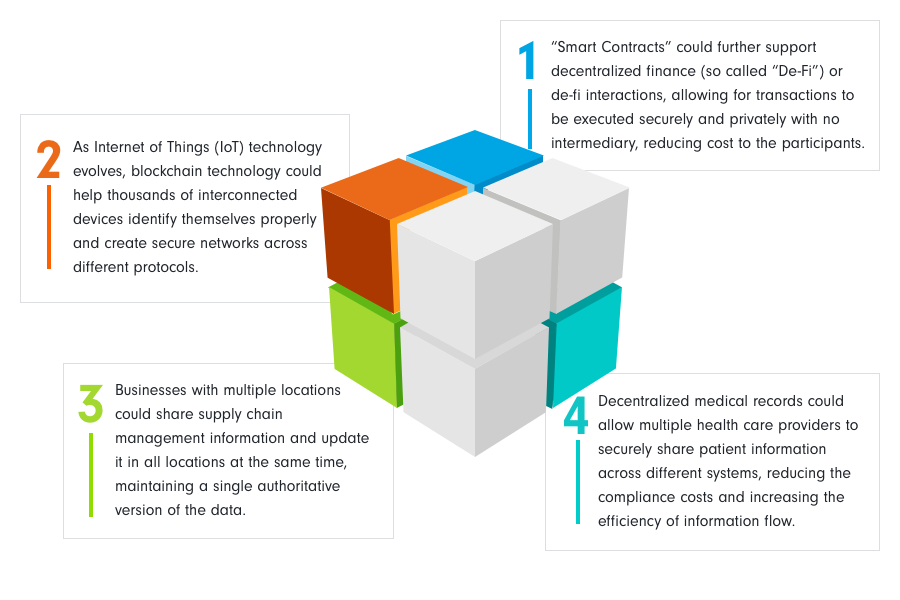
We believe the future of asset management will increasingly involve digital assets – and understanding them today will be key to unlocking the potential (or avoiding the risks) that they present to you or your client's portfolio in the future.
Cryptocurrency, as a digital alternative to government-issued fiat currency, is one of the most talked-about forms of digital asset. But, just as there are different asset classes in the traditional financial system, digital assets could be best understood by categorising them.
Each category represents a different set of risks and will likely attract different regulation, both of which are critical in the context of investment decisions. However, because digital assets can be programmed and combined, the boundaries between categories can become fluid and overlaps are unavoidable.
This is the reason why investors should have a basic knowledge, at least, of the main features of the different categories.
The tremendous acceleration digital assets have had in the last decade has not solved all problems yet. A fragmented market, increasingly complex technological requirements, lack of clear regulatory frameworks make the institutional investors' journey into digital assets more complex than traditional asset classes with familiar and established landscapes.
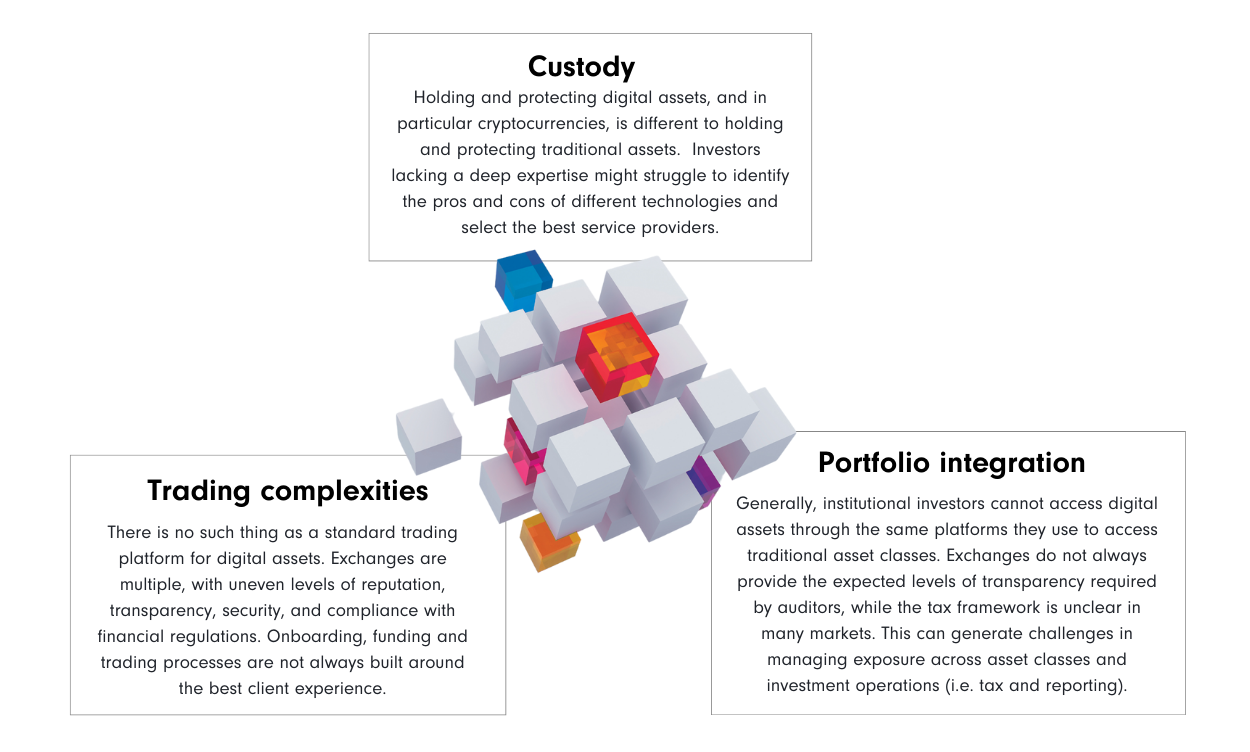
Challenges for investors include those associated with custody, trading complexities and portfolio integration summarised below.
Important information
This document is being distributed in Taiwan only to Financial Institution Clients which fall under the definition of "Financial Institution Clients" as referred to the provisions of Article 3, Paragraphs 3 and 4 of the Regulation Governing Offshore Structured Products.
Digital assets are speculative and highly volatile, can become illiquid at any time, and are for investors with high-risk tolerance. Investors in digital assets could lose the entire value of their investment.
The contents of this document are provided by Fidelity Management & Research Company LLC. No action has been taken by Fidelity Securities Investment Trust Co. ( Taiwan ) Limited ( “FIL SITE” ) to assess, confirm or verify the timeliness, sequence, accuracy, adequacy, completeness or any other aspect of the information or opinions contained in this document. FIL SITE ( including directors and employees ) do not accept any liability for the information contained in this document. The information and opinions contained may change.
Fidelity only offers information on products and services and does not provide investment advice based on individual circumstances. We recommend that you obtain detailed information before taking any investment decision. Investments should be made on the basis of the current prospectus / offering documentation. Certain statements contained in this document are based on current expectations, estimates, projections, opinions, and / or beliefs and constitute "forward-looking statements", which can be identified by the use of forward-looking terminology such as "may", "expect", "anticipate", "project", "estimate", "intend", "target", or "believe", or comparable terminology or the negatives thereof. No representation or warranty is made with respect to such statements and future events may differ materially from those reflected or contemplated in such statements. As a result, investors should not rely on such forward-looking statements in making their investment decisions.
No statements or representations made in this document are legally binding on Fidelity International or the recipient. Third party trademark, copyright and other intellectual property rights are and remain the property of their respective owners.
Fidelity, Fidelity International, the Fidelity International logo and F symbol are registered trademarks of FIL Limited. FIL Limited and its subsidiaries are commonly referred to as Fidelity International. Fidelity Investments refers collectively to FMR LLC, a US company, and certain subsidiaries, including but not limited to Fidelity Management & Research Company LLC. Fidelity International and Fidelity Investments do not belong to the same group of companies.
Fidelity Securities Investment Trust Co. ( Taiwan ) Limited
No. 004 of 2023 Jin-Guan-Tou-Xin-Sin
11F, No. 68, Section 5, Zhongxiao East Road, Xinyi District, Taipei
Service line: 0800-00-9911
Website: http://www.fidelity.com.tw
FIL SITE operates independently in Taiwan.