
Important Notice
This information must not be reproduced or circulated without prior permission. Strictly for qualified professional institutional investors defined under the provisions of Article 3, Paragraphs 3, Subparagraph 1 of the Regulation Governing Offshore Structured Products.
ETFs, reimagined
How market needs and ETF innovation are converging to create more versatile active solutions
By Tom Taw, Head of ETF Distribution, Asia Pacific ex Japan

The ETF wrapper is commonly used as one of several tools in portfolio construction. ETFs may offer features such as liquidity, operational efficiency and market access. Yet, in a market where correlations are converging and cap-weighted indices are channelling capital toward a narrower set of market leaders, there are growing questions about whether those qualities alone continue to align with investors’ risk tolerance and long-term objectives.
Some investors and market participants have shown interest in approaches that allow more precise implementation of investment views, combine exposures more deliberately, and access differentiated sources of return.
What investors seek to achieve has shifted and how they implement it has evolved as well, creating new possibilities for portfolio construction.
When implementation shapes outcomes
Index investing remains one of the most important innovations in modern finance. However, index investors face a growing challenge – concentration risk. In the past, index funds offered broad market diversification across sectors and industries.
Today, investing in index funds has become one of the most consequential active allocation decisions investors make, as market-cap-weighted indexes have become overconcentrated around a single dominant theme: artificial intelligence ( AI ).
Holding broad market exposures tracking the S&P 500 Index or MSCI Korea has effectively become a high-conviction bet on the durability of the AI trend, given the outsized weight of AI-related companies in these benchmarks. The degree of diversification that passive broad-market exposure once offered has been diminished.
Chart 1. AI's explosive growth
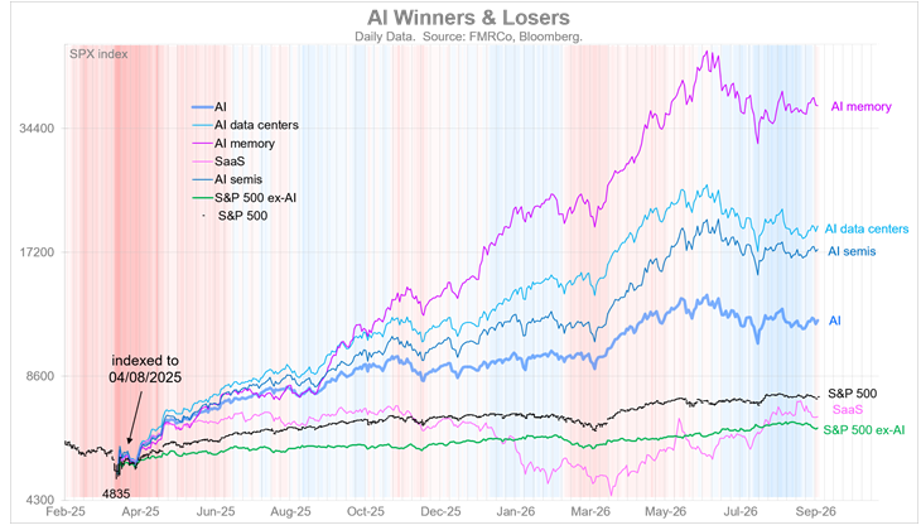
Source: Fidelity Investments, September 2026. Past performance is not indicative of future returns.
At the same time, the risks remain real. The underlying economics of the AI trade remain uncertain. The technology has yet to produce the broad-based productivity gains that many expect will ultimately justify the enormous expenditures on data centres, chips, power, and connectivity. Chinese memory-chip manufacturers and AI model developers are emerging as credible competitors to some more established players. Moreover, recent security concerns have also led to calls for a coordinated slowdown in the development of frontier AI models to manage risks, with potential implications for future capex expansion.
Over the past year, that uncertainty has begun to seep into the composition and volatility of the trade itself. During that time, the biggest winners have not been the mega-cap hyperscalers that led markets higher in the earlier stages of the melt-up, but some of their key suppliers: the semiconductor and memory makers benefiting most directly from the hundreds of billions committed each quarter to the AI capex super-cycle and the scarcity this has created for their own products. Even then, growing concerns about the risks facing those new leaders triggered a jarring pullback from their previously explosive gains.
Investors face decisions on whether to stay invested and benefit from any further market gains, or become more defensive in case markets decline.
Consequently, a growing number of market participants seek to build portfolios that better reflect their convictions and risk budgets by combining solutions in a more modular way, for example:
- passive approaches to potentially capture broad market upside or specific factors or sources of returns
- systematic or research-enhanced active approaches that seek above-index returns, and
- high-conviction, targeted active exposures
Other strategies may seek to manage downside risk or to take advantage of the renewed stock-selection opportunities within small caps – all through the same liquid, transparent vehicle and familiar onboarding, governance and reporting framework within an ETF structure.
ETF innovation increases active choices
While investors' needs evolved, so did the trading infrastructure and regulatory frameworks that support active ETF implementation, including changes in disclosure, liquidity and portfolio construction requirements.
This evolution is marked by three key developments:
Expansion of the opportunity set
Historically, certain active strategies were better suited to traditional mutual fund structures. For highly research-driven managers, immediate portfolio disclosure presented practical challenges. Revealing positions in real time could expose proprietary views, create replication risks, and increase trading frictions, particularly in less-liquid parts of the market.
New ETF disclosure frameworks have helped address some of these concerns. By introducing greater flexibility around portfolio transparency while preserving the creation and redemption mechanisms central to ETF trading, these structures have expanded the range of strategies that can be offered in ETF form.
Reframing of the active spectrum
The traditional active vs passive distinction has become an outmoded way of describing the options for constructing portfolios. Between fully discretionary stock-picking and market-cap-weighted indexing sits a growing universe of approaches that blend elements of both.
Enhanced index strategies, systematic active portfolios and benchmark-aware mandates are examples of this middle ground. They combine quantitative research, portfolio construction discipline and active decision-making while maintaining a close relationship to broad market exposures.
Their role is not necessarily to maximise tracking error or pursue concentrated alpha. Rather, they offer investors additional choices regarding how much active risk to take, where to take it and how tightly portfolios should remain anchored to a benchmark. As inherently liquid, benchmark-aware strategies, they can add to the potential efficiencies of the ETF wrapper, providing a natural way to re-imagine core exposures, whether as a replacement for or complement to passive ETFs.
Designing for more diverse outcomes
Portfolios are increasingly organised around specific objectives rather than broad asset-class labels. Balancing income generation, diversification, duration management, inflation resilience, thematic exposure and alternative return streams often require multidimensional implementation considerations.
Improved liquidity management techniques and more sophisticated portfolio construction approaches have expanded the range of exposures that can be efficiently delivered through the active ETF wrapper. An income-focused investor may care as much about the sustainability and quality of yield as the headline level of income itself, or even whether it’s sourced through fixed income or an alternatives-based strategy. Within fixed income, investors increasingly have access to tools designed around specific duration, credit or liquidity objectives rather than broad aggregate exposures.
These developments have given investors an even more refined set of building blocks with which to complete the portfolio rebuild.
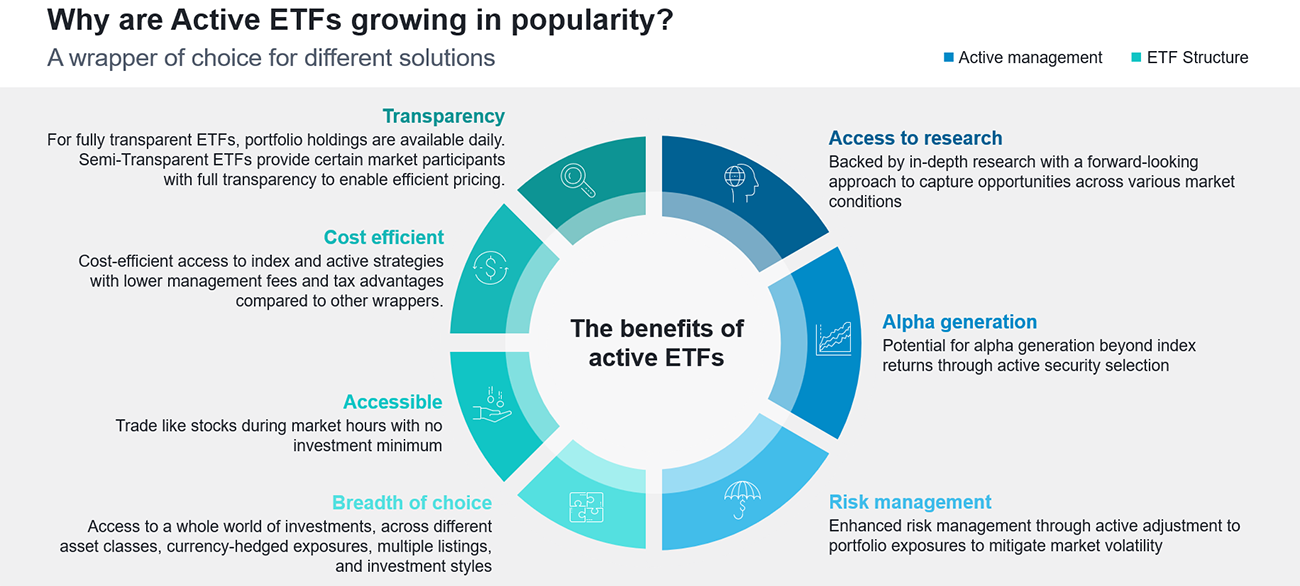
Source: Fidelity International, 2026. For illustrative purposes only.
The next chapter
Shifting market dynamics have sharpened the focus on what lies beneath broad asset allocations. Investors now seek more selective and precise ways to express those views without undermining the efficiencies and operational advantages a generation of ETF-centric construction helped bring about. The development of active ETFs represents one possible solution to this challenge, enabling investors to combine research, portfolio construction, and active judgment to access the exposures they seek while managing the risks they wish to avoid.
Important Information
This document is being distributed in Taiwan only to Financial Institution Clients which fall under the definition of “Financial Institution Clients” as referred to the provisions of Article 3, Paragraphs 3 and 4 of the Regulation Governing Offshore Structured Products.
The contents of this document are provided by Fidelity Management & Research Company LLC. No action has been taken by Fidelity Securities Investment Trust Co. ( Taiwan ) Limited ( “FIL SITE” ) to assess, confirm or verify the timeliness, sequence, accuracy, adequacy, completeness or any other aspect of the information or opinions contained in this document. FIL SITE ( including directors and employees ) do not accept any liability for the information contained in this document. The information and opinions contained may change.
Fidelity only offers information on products and services and does not provide investment advice based on individual circumstances. We recommend that you obtain detailed information before taking any investment decision. Investments should be made on the basis of the current prospectus / offering documentation. Certain statements contained in this document are based on current expectations, estimates, projections, opinions, and / or beliefs and constitute "forward-looking statements", which can be identified by the use of forward-looking terminology such as "may", "expect", "anticipate", "project", "estimate", "intend", "target", or "believe", or comparable terminology or the negatives thereof. No representation or warranty is made with respect to such statements and future events may differ materially from those reflected or contemplated in such statements. As a result, investors should not rely on such forward-looking statements in making their investment decisions.
No statements or representations made in this document are legally binding on Fidelity International or the recipient. Third party trademark, copyright and other intellectual property rights are and remain the property of their respective owners.
Fidelity, Fidelity International, the Fidelity International logo and F symbol are registered trademarks of FIL Limited. FIL Limited and its subsidiaries are commonly referred to as Fidelity International. Fidelity Investments refers collectively to FMR LLC, a US company, and certain subsidiaries, including but not limited to Fidelity Management & Research Company LLC. Fidelity International and Fidelity Investments do not belong to the same group of companies.
Fidelity Securities Investment Trust Co. ( Taiwan ) Limited
No. 004 of 2023 Jin-Guan-Tou-Xin-Sin
11F, No. 68, Section 5, Zhongxiao East Road, Xinyi District, Taipei
Service line: 0800-00-9911
Website: http://www.fidelity.com.tw
FIL SITE operates independently in Taiwan.